A use of funds slide seems simple. A startup is raising capital, so the founders divide the round between product, hiring, marketing, and operations, turn those numbers into a chart, and move on.
That is why so many of these slides look almost identical: 40% product, 30% marketing, 20% hiring, 10% operations. There is nothing inherently wrong with this breakdown, but it does not tell an investor very much. The more important questions are why the company needs this amount of money, how long it should last, and what the business should be able to achieve before that capital is spent.
A strong use of funds slide is therefore not just a budget. It connects the capital being raised with the next stage of the company.
What a Use of Funds Slide Should Actually Explain
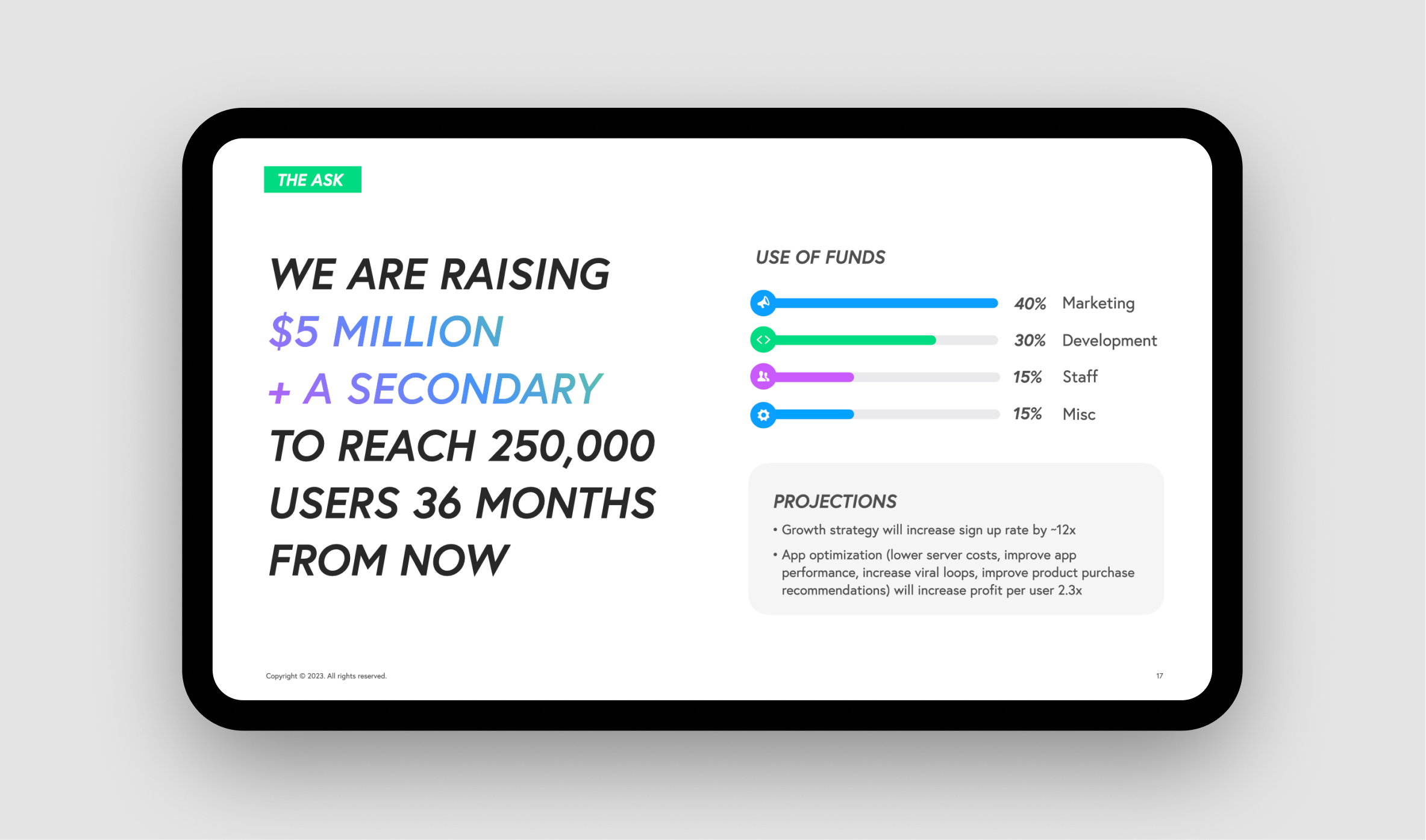
At the most basic level, the slide shows how a startup intends to deploy the capital it is raising. Depending on the business, that may include product development, hiring, sales and marketing, infrastructure, research, regulatory work or expansion.
But investors are not funding expenses for the sake of funding expenses. They are backing a company because they believe capital can help it make meaningful progress. The real purpose of the slide is to show what that progress should look like.
This is especially important in venture-backed startups because the company will often need to spend more than it currently generates in order to move quickly. At an early stage, capital may be needed to build an MVP, hire the first team members and test whether customers actually want the product. Later, it may be used to develop repeatable acquisition channels, improve the product and move toward product-market fit. Once the model is working, the focus increasingly shifts toward scaling it.
The use of funds should reflect that stage. Spending heavily on sales before demand has been validated can look premature. At the same time, a company that already has a strong product and customer demand may need distribution far more than another year of product development.
The allocation tells investors something important about how well the founders understand their own business.
Connect the Raise to Runway and Milestones
One of the weakest things a fundraising deck can say is simply:
We are raising $2M for product development, hiring and marketing.
The immediate question is: why $2 million?
A more convincing answer connects the raise with a period of execution and a set of measurable outcomes. For example, the company may be raising $2 million to provide 18 months of runway, complete an enterprise product, build its first sales team and grow to $1 million ARR.
Now the investor can understand what the round is supposed to accomplish.
A useful way to think about this is:
Raise → Runway → Execution → Milestones
This does not mean founders need to predict exactly where the company will be 18 months from now. Startup plans change constantly. But there should be a credible hypothesis about what this capital is expected to unlock.
That idea is also important beyond the pitch deck itself. Raising a round is not the finish line. Once investors provide capital, the company has to deploy it in a way that increases the value of the business and creates a stronger position for whatever comes next.
Each Round Should Prepare the Company for the Next One
For most venture-backed startups, one fundraising round is not the final destination. A Pre-Seed round may be used to reach the traction required for Seed, while Seed capital should ideally move the company toward the metrics that make a future Series A possible.
This is another reason why the use of funds should be connected to milestones. Investors want to see that the capital is sufficient not only to keep the company operating, but to bring it to a materially stronger position. That could mean reaching a certain level of revenue, proving retention, building a repeatable acquisition model, launching the product or hitting another KPI that makes the next stage of the business fundable.
The exact timeline will vary, and founders do not need to promise a rigid fundraising roadmap. But showing that there is a logic behind the current raise makes the plan more credible. For example, a company might explain that the current round is expected to provide 18 months of runway and reach the milestones required to prepare for a Series A.
The key question is: when this capital is spent, will the company be strong enough to raise its next round on better terms?
The Use of Funds Should Change as the Company Grows
There is no universal allocation that works for every startup because the role of capital changes as the company develops. At Pre-Seed, funding is often used to build the product, test key assumptions and reach the first signs of validation. At Seed, the focus usually shifts toward strengthening the product, growing the team and proving that customer acquisition and retention can become more repeatable. By Series A, capital is increasingly used to scale what has already shown evidence of working.
The exact percentages will differ from company to company. What matters is that the allocation reflects the startup's current bottleneck and helps it reach the milestones needed for the next stage. Money should be directed toward the most important constraint between where the company is now and where it needs to be next.
What a Strong Use of Funds Slide Can Look Like

Consider a startup raising a $2 million Seed round.
A basic version of the slide could show this:
Category
Allocation
Product & Engineering
35%
Sales & Marketing
30%
Team Expansion
25%
Operations
10%
That gives the investor a quick overview, but the slide becomes much stronger when the allocation is connected to the plan behind it.
The company could explain that product spending will fund enterprise features already requested by its pipeline, sales and marketing will be used to build repeatable acquisition channels, and hiring will cover five key roles needed to execute the plan. Alongside the allocation, it could show 18 months of runway and a few target milestones such as $1M ARR, 120+ customers and repeatable acquisition economics.
The percentages have not changed. What changed is the amount of information investors can take from them.
This is also why percentages and dollar amounts can both be useful. Percentages make the structure easy to understand at a glance, while dollar amounts make the scale more tangible. There is no need, however, to turn the slide into a financial model. Detailed salaries, monthly software expenses and every operational assumption belong elsewhere.
The pitch deck should communicate the logic, not every line item.
Common Mistakes
The most common mistake is treating the use of funds slide as a pie chart instead of part of the fundraising story. Categories such as "growth," "operations" or "development" are too broad if investors cannot understand what they enable.
Another problem is disconnecting the slide from the financial model. If the deck suggests that the round provides 20 months of runway while the financial forecast shows that cash runs out in 11, the issue is no longer presentation - it is credibility.
It is also worth being careful with milestones that are either too vague or unrelated to the next stage of the company. "Grow the team" or "increase awareness" may describe activities, but they do not tell investors whether the business has become stronger. Milestones should show progress: a product launch, a revenue target, customer growth, stronger retention, regulatory approval or another result that materially changes the company.
Think About Progress, Not Just Spending
Before building the slide, founders should be able to answer four basic questions: how much are we raising, how much runway will it give us, what are the main areas where that capital will be deployed, and what should the company achieve during that period?
If those answers are clear, the slide itself is usually straightforward.
A fundraising story might ultimately be as simple as:
$2M raise → 18 months runway → product + team + go-to-market → $1M ARR and Series A readiness.
That is the point of a strong use of funds slide. Investors do not need a prettier explanation of how a startup plans to spend money. They need to understand how that money is supposed to move the company forward.
The best slides make that connection obvious: this is where we are today, this is the capital we need, and this is where it should take us.
If you are preparing for a raise and your use of funds slide still feels too generic, book an intro call with 100PitchDecks. We can help connect your fundraising ask, runway, and milestones into a clearer story investors can quickly understand.
Artem Pochepetsky is the founder of 100PitchDecks and a pitch deck strategist working with founders across pre-seed, seed, and Series A.